Showing posts with label Hookah Culture. Show all posts

Thursday Thirteen: Hookahs in the Movies

Header from samulli
Click here to see other entries or to play along.


We've sold hookahs to at least two different production companies in the past year. Interestingly, they let us know that they would be using our hookahs in the movies they were making, but neither company was at liberty to reveal the name of the films. Whether this was just a marketing strategy on their part to get us to go to the theater more often in the hopes of seeing our hookahs on the big screen or some kind of legal issue, we don't know. But, it did inspire our list of 13 movies in which hookahs appear. Enjoy!


Hookahs and Hollywood

1. Hidalgo: We'd be disappointed if this movie didn't have a hookah in it considering that it is the story of a horse race in Arabia!


2. (Indiana Jones and the) Raiders of the Lost Ark:


3. Star Wars: Pop culture's most famous -- or should we say, INfamous -- hookah smoker is, without a doubt, is Jabba the Hut of Star Wars fame. Not your everyday pipe, Jabba's hookah has a special bowl at the bottom where he keeps various live "snacks." This dude is also a serious hookah fan, as he is hardly ever seen without his pipe.


4. Disney's Aladdin: At the beginning of the movie, a merchant who tries to sell the lamp and tells its story, has a hookah for sale. It's not just any old old hookah, though, it's a combination hookah and coffee maker that also makes julienne fries. Now that's one heck of a hookah!


5. The Spy Who Loved Me: Among the gadgets in Q's lab are a decapitating tea tray, a spring mounted pouffe, a hookah that doubles as a machine gun, and a camel saddle that conceals a large spike.


6. Casablanca: Set in Morocco, where the hookah is part of everyday life, it's no wonder that Bogie's best known movie has a hookah in it!


7. The Matrix Reloaded: The twins are smoking an Indian style hookah.


8. Lock, Stock, and Two Smoking Barrels: It's not easy to see, but there's a hookah in this scene!


9. 300: We looked far and wide, but couldn't find a picture for this one. Trust us, though, there be hookahs in this film.

10. Algiers: Movie buffs might be familiar with this golden oldie starring Charles Boyer and Hedy Lamarr.


11. Casino Royale: Mata Bond, said to be the "love child" of James 007 Bond and Mata Hari, is an accomplished belly dancer and hookah smoker.

12. Rendition: A CIA agent receives a phone call from his boss while he's smoking hookah in a belly dance club. Considering that this film is about Muslim terrorists, we shouldn't be too surprised to find a hookah in it.

13. Alice in Wonderland: Disney's famous hookah-smoking caterpillar is, by far, the most famous hookah smoker in the world of film!


And before we sign off, there are a few other films we discovered with hookahs: Click, Octopussy, and Pirates of the Caribbean at World's End. There are probably lots more, especially among the film classics.


Updates & Saalaam SPICED CHAI Review

Hey, folks, it's been a while since I had time to do any posting to the blog, and I'm really sorry for that. Lots of things have been going on since my last post, so here's a quick recap:


  • Because California's budget sucks right now, I took a REALLY early retirement from teaching. It was getting too stressful having to worry about whether or not my contract would be honored and if I'd lose my health insurance. When you've got a serious brain issue or having seizures like I do, you just can't afford to be without health care coverage. So to guarantee that I keep it, I had to retire. Maybe now I'll have time to post more regularly!

  • We've got an air cargo container of Khalil Mamoon (KM) pipes coming to us in the next couple of weeks. It should have 10 of each style they make, so that's kind of exciting. Keep your eye out here for the announcement of their arrival and sale.

  • The response to Saalaam Herbal Shisha surpassed anything we could have imagined. We know that some people prefer the buzz that comes along with using the tobacco brands, but we are thrilled to be supplying two local hookah lounges that serve Saalaam exclusively! It has also gone international, with representatives now in Russia and Latvia, and and negotiations on-going with reps in the Netherlands (Holland), Germany, the UK, Canada, and Australia. It's hard to imagine that back a couple of summers ago, when we recruited some of our regular customers to be samplers for us, that we'd see the success that we have. Thanks again, guys -- you know who you are!


We're working on a summer contest for one of those KM pipes I mentioned and as soon as we get the details all worked out with the legal peeps, I'll post it here. In the meantime, look for more regular posting from me as I branch out into areas that are related to hookahs without spending all my time talking just about the pipes. You'll soon find recipes for Egyptian food, photos of people and places to see in Egypt, virtual vacations to the Land of the Pharoahs, and lots more. I hope that you'll hang around and join in the fun!

House Passes Tobacco Bill, 298-112

Congressman Henry Waxman, of California's 30th District (Los Angeles), can now play Yankee Doodle and add a feather to his hat with the House passage of HR1256, the Family Smoking Prevention and Tobacco Regulation Act. The bill, which seeks to assign the authority of tobacco regulation to the FDA, passed a House vote yesterday with 298 representatives saying AYE and only 112 saying NAY. The New York Times has provided a roll call of the voting here. How did your representative vote?

The bill is now set for a Senate vote, but it will likely face stronger opposition there than it received in the House. Representing the largest tobacco producing state in the nation, Republican Senator Richard M. Burr, of North Carolina, has threatened a filibuster. But with Senator Edward Kennedy and Philip Morris USA backing HR 1256, and our new President on board, Senator Burr will more than likely have the proverbial uphill battle to wage. Interestingly enough, the Supreme Court denied an appeal to Philip Morris USA on March 31, 2009, in a landmark fraud case that awarded $79.5 million to a Portland, Oregon widow whose husband, a long-time smoker, died of lung cancer (see Philip Morris USA v Williams, 07-1216). The appeal has been bounced around the court system for 10 years and has racked up enough interest to make the award worth $155 million today. I can't help but wonder if Philip Morris USA will change its mind about supporting HR 1256 in light of this. After all, they will need smokers to buy their products in order to recoup their losses, right?


Remember, folks, HR 1256 has a direct impact on your right and ability to smoke hookah! Should the bill pass the Senate and become law, adding flavoring to tobacco will become illegal. Flavoring is the very heart of hookah tobacco!


What can you do?


Contact your senators and voice your opinion. Stand up and be heard!

John Stuart Mill and Hookah Bans

"The only freedom which deserves the name is that of pursuing our own good in our own way, so long as we do not attempt to deprive others of theirs, or impede their efforts to obtain it. Each is the proper guardian of his own health, whether bodily, or mental or spiritual. Mankind are greater gainers by suffering each other to live as seems good to themselves, than by compelling each to live as seems good to the rest." --John Stuart Mill, On Liberty

If I couldn't laugh about the irony of it, the latest smoking ban would have me crying. Virginia, a state whose economy depends on the manufacture of tobacco products (tobacco manufacturing is still the state's number one industry), has recently passed a sweeping anti-smoking law that will more than likely put several restaurant and bar owners out of business.


According to the Washington Post, this bi-partisan bill was "hatched in closed-door meetings between Gov. Timothy M. Kaine (D) and House Speaker William J. Howell (R-Safford)." Although the new law doesn't reach quite as far as some of the more virulent anti-smoking groups wanted, it does go far enough to target places where smoking has been an accepted part of business for generations. With all the secondhand smoke hype that the media has subjected us to, I can't help but wonder why anyone who is genuinely worried about secondhand smoke exposure would continue to work in establishments that permit smoking or, more importantly, why anyone who chooses not to work in an area where smoking is allowed is so concerned about those who do.

John Stuart Mill, in his essay, On Liberty, says it best: "The only purpose for which power can be rightfully exercised over any member of a civilized community, against his will, is to prevent harm to others. His own good, either physical or moral, is not sufficient warrant." In other words, don't try to stop me from smoking hookah in a shop made specifically for that purpose because you think that the secondhand smoke may cause harm to others. An alternative is available: if you don't want to be subjected to secondhand smoke, avoid places of business that permit smoking. Problem solved. Duh!


Related Links


On Milton, Censorship, and Hookahs

I've admired John Milton's work for many years. Scholars consider his epic work, Paradise Lost, the greatest poem ever composed in the English language, and I concur; however, it is a piece of his prose that I prefer.

"To sequester out of the world into Atlantic and Utopian polities, which never can be drawn into use, will not mend our condition. . ."

Written in 1644, Areopagitica is a passionate argument against censorship. But much of what Milton has to say about why banning certain books is a bad idea can also be used to argue that the current trend toward smoking bans is equally futile.

The notion that society must be "protected" from harmful things fuels much of the debate on smoking. The same argument is used to challenge books that certain groups of people find offensive. Instead of exercising their right to choose reading materials for themselves and allowing others to do the same, these groups seek to "protect" us from what they perceive to be "harmful." In essence, this means that the rest of us are too stupid to make the "right" choices. Rather than relying on the individual to decide the value of a book, special interest groups want to tell the rest of us which books have "true" worth based upon their value judgments with the underlying assumption being that their values are superior because they are "right." Milton contends, however, that attempting to construct a Utopian paradise where only good exists will not solve the problem and gives us a rational explanation why:

"They are not skilful considerers of human things, who imagine to remove sin by removing the matter of sin . . . Though ye take from a covetous man all his treasure, he has yet one jewel left, yet cannot bereave him of his covetousnes. Banish all objects of lust, shut up all youth into the severest discipline that can be exercised in any hermitage, ye cannot make them chaste that came not thither so; such great care and wisdom is required to the right managing of this point."


Removing an object of desire from society does not make the desire for that object disappear! The Volstead Act, which became the Eighteenth Amendment, is the perfect example to illustrate Milton's argument.

The Prohibition of alcohol in America was sparked by the ardent desire of a handful of women and religious activists who believed that removing the demon alcohol -- the sin in Milton's equation -- would protect and improve American society. Unfortunately, as history proved, removing the object of sin was not enough to solve the problem, for the desire for the object remained. Instead of creating a Utopian paradise free of alcohol and the negative consequences of drinking it, those who successfully pushed for Prohibition created new problems, some of which are still being dealt with nearly 100 years later. Because Prohibition was unenforceable, the attempt to remove alcohol from society caused
an alarming increase in crime and increased alcohol consumption instead of bringing it to a complete stop.

Prohibition failed because the desire for alcohol was not removed with the passage of the Eighteenth Amendment. The same holds true for the current smoking bans. Closing hookah bars and banning smoking from places where only adults congregate will not convince people to stop smoking, but it will have a negative effect on the livelihoods of those who must now ban smoking patrons from their establishments! Furthermore, just as Prohibition led to a 516 percent increase in alcohol-related crimes, individuals whose businesses depend on smoking patrons will seek ways to get around the laws in order to keep their businesses afloat. To wit, check out
Pipe Ban Is a Pane, France's Smoking Ban Chokes Hookah Bars, or Proposed Tougher Smoking Laws Have Some Richardson Businesses Worried.

Clearly a "skilful considerer of human things," John Milton, a man of the 17th century, had a better understanding of human nature than the lawmakers of the 21st century. The good news is that although the British Parliament did not heed his advice regarding the censorship of books, the Areopagitica played a significant role in our Founding Fathers' understanding of the importance of free speech and press. One can always hope that Milton's influence will still be felt and that "skilful considerer[s] of human things" will come out from behind the smoke screen of political correctness.

Hookah Etiquette: East Meets West Halfway

The Middle East is a region rich in tradition and custom, where certain behaviors govern social interaction, so it should come as no surprise that a set of expectations, or etiquette, surrounds smoking the hookah, too. As the hookah's popularity spread across the ocean to the West, the rules of etiquette evolved to suit the different lifestyles of the smokers. I thought it would be interesting to see how the East meets the West when it comes to hookah smoking behavior.

Eastern Hookah Etiquette

*First and foremost, smoking hookah is about social interaction. Smokers gather around a hookah, whether by sitting around a table together or in a circle on the floor, thus enabling them to see one another face-to-face and to communicate comfortably.

*Relaxation is key to hookah enjoyment. Smoking hookah takes time, moves slowly, and is never hurried. Enjoy a cup of
tea Middle Eastern style, Turkish coffee, or Arabic coffee and share the events of the day with friends. Alcohol is not part of the hookah tradition in the Middle East.

*Keep the competition for the soccer (football) field. There's no need to compete with friends for a turn with the narghile, so smokers take their time with the hose and pass it along only when they are satisfied.

*Don't blow smoke! In the faces of others, that is. Watch where those smoke rings go because it is considered rude to blow smoke at or near others. It is best to exhale in an upward or sideways direction, allowing the smoke to go over the heads or away from the faces of the others in the group.

*
Hoses belong in the right hand. Because people in the Middle East use the left hand for personal hygiene, it is considered unclean and should never be used to smoke hookah.

*The hookah belongs on the floor not the table. As a service object, the argile should never be placed on the same level as those whom it will serve. The average height for an
authentic Middle Eastern hookah is 32" (81 cm) to accommodate its placement on the floor while making the hose(s) and head easy to reach.

*Don't pass the hose directly unless absolutely necessary. The proper way to indicate that the hose is available for another smoker is to place it on the table for someone else to pick up. If the hose must be passed to the next user, hold it in the right hand and keep the tip pointed at yourself.

*Although not a common practice, smoking a cigarette during a hookah session is rude only when the cigarette is lit from the
narghile charcoal or the ashes dumped on the hookah tray.

Western Hookah Etiquette

*Smoking hookah is an individual as well as a group activity, thus it is not unusual to find people who enjoy their pipes without sharing.

*Relaxation is not always of prime importance to a smoking session. Hookah lounges in the U.S. often have loud music or a television blaring in the background, making conversation challenging at best. Many Western smokers mix argile and alcohol which sometimes causes raucous behavior and a total loss of manners.

*Competition is an issue only when it comes to who gets the biggest smoke cloud or makes the best smoke rings. Smokers typically take only a puff or two before passing the hose off to someone else.

*Blowing smoke directly in someone's face is rude, but sharing smoke mouth-to-mouth is cool. Go figure!

*Holding the hose in the right or left hand doesn't matter. Individual smokers typically use their dominant hand.

*Smokers may still gather around a hookah, but the pipe is often placed on the table instead of the floor. Although this practice breaks with the traditional rules of etiquette, it does elevate the hookah to a place of admiration so that smokers can marvel at its beauty. This practice also allows for the use of
shorter hookahs.

Whether you follow the traditional etiquette or enjoy the adaptations of the rules made in the West, smoking hookah is meant to be an activity that allows you to escape from the hectic and often frantic pace of everyday life. So enjoy the hookah experience with or without these rules!

Hookahs: Does "Modern" Mean "Better"? / Part II

When the hookah trend took off in the U.S., entrepreneurs began looking for ways to meet the market demand. Importing traditional hookahs from the Middle East takes a lot of time, patience, connections, and money; therefore, up and coming businesspeople sought alternative suppliers. One enterprising individual, the founder of Sultan Tobacco, decided that the basic hookah could be mass produced in an assembly line manufacturing environment with greater ease than importing the traditional pipes would be. Mike, also keenly aware of the American "on-the-go" mentality, sought to make a hookah that could be transported with ease. And so the Junior, a single hose hookah in a carrying case, the first "modern" hookah, was born.

Although sending the hookah to China for manufacture met the market demand for pipes, and reduced the price for consumers, the modern technology employed in the manufacturing process didn't improve the hookah at all. Instead of improving the hookah experience for enthusiasts, the "modern" hookahs did nothing more than flood the market with thousands of look-alike pipes in boxes.

Thanks to the cheap cost of purchasing a "modern" hookah, they sold like the proverbial hotcakes. We watched this phenomenon with a great deal of interest because unlike others in the business, we refused to jump on the Chinese bandwagon. And we are eternally thankful that we stuck to our guns, for it wasn't long after these modern "marvels" hit the market that we began to see the fallout.

Because modern technology has made these hookahs look perfect, buyers assume that they are every bit as good as they look; however, they quickly learn about just how deceiving appearances can be when it comes to a product's performance and longevity. In order to make international sales more appealing, Chinese factories do everything they can to reduce production costs. We've seen this recently with the
massive recall of toys and other products made in China due to the presence of lead. In terms of hookah production, costs are cut in myriad ways:

  • inferior and/or cheaper metals are used in the manufacture of the shaft
  • the glass is spray painted instead of using colored glass
  • glass designs are spray painted by pre-set machines
  • because hookahs are assembled in a package, replacement parts are almost non-existent

When cheap metals are used, the shafts are spray painted. And this is where we first began to see the problems with the Chinese pipes. Customers came to us looking for a solution to the problem of the paint peeling off the shaft and the resulting rust spots that occur after exposure to the water in the base. Oftentimes, they came to us as a last result because they could find no replacement parts anywhere. Other customers came to us looking for replacement bases after theirs broke or the paint peeled off. But the manufactured hookah does have some good points, too:

  • cheap purchase price
  • uniformity in appearance
  • ease of use
  • convenient to store and travel with

While the initial investment in a visually appealing and conveniently portable Chinese manufactured hookah is low, the costs involved in maintaining it only increase that investment exponentially. Most of the time, people who have purchased the "modern" hookahs end up replacing them with the traditional ones because they can find parts and accessories for them that are unavailable for their technologically "advanced" pipe.

Considering the dangers associated with the possibility of lead contamination (remember that in addition to smoking tobacco, you are smoking the materials used in the pipe itself!), flaking paint and rust spots on shafts, peeling paint on glasses, and the lack of replacement parts are taken into consideration, it's not too hard to see that "modern" may mean cheaper, but it does not necessarily mean "better."

Hookahs: Does "Modern" Mean "Better"? / Part I

"It troubles me that we are so easily pressured by purveyors of technology into permitting so-called "progress" to alter our lives without attempting to control it -- as if technology were an irrepressible force of nature to which we must meekly submit." -- HYMAN G. RICKOVER, quoted in The American Land, 1979.

Technology vs. Tradition

Modern technology is, in countless ways, a double-edged sword. While our gadgets provide us with convenience and short-term pleasure, many of them also imprison and isolate us. Devices that we attach to our heads or plug into our ears may give momentary pleasure and distraction, but they also have the power to isolate us socially and imprison their users in a cell of ignorance. At the university where I teach, students meander through the quad and hallways with various and sundry devices attached to their heads and no social interactions taking place among their peers. Instead of the sound of lively after class discussions of lectures as students move from one class to the next, the loudest noise heard in the halls of academe is often little more than the click-clack of heels on the waxed tiles. Technology has usurped tradition on many university campuses and although students seem to prefer being "plugged in" and "dropped out" of social interaction, the meteoric rise of the hookah trend shows us that appearances can be truly deceiving.


The h
ookah has been Middle Eastern cultural icon for centuries. Visit the oldest parts of any Middle Eastern city, and you will find a qahwa (Arabic for coffee shop). The qahwa is a hub of social activity; it is the place where friends gather to share a cup of tea, a game of cards, backgammon or chess, politics, jokes, and a hookah. As Naguib Mahfouz, the Egyptian Nobel Prize winning author, writes in his novel, The Children of Gebelawi (Awlad Haretna in Arabic), the qahwa is the place where the memories of the glorious past meet the hardships of the present and both are shared with friends. Sharing, the very essence of the hookah culture, is a tradition that contributes to the proliferation of hookah lounges across the US. They are places where young and old can unwind from the stress of work, home, and school; reconnect with old friends and meet new ones; and most importantly, once again engage in the traditional act of face-to-face socializing that technology seems to have stymied.


Since hookahs take center stage at the qahwa of the Middle East and the lounges of the West, it is important that we take a look at how technology has impacted them as well. And that discussion will come in Part II.

Hookah News

It's always interesting to see how the hookah fares in the media, so this morning I googled "hookah" just to see what I could find. In addition to the usual anti-smoking hype, the search brought some some fun reads that I've decided to share.

Bookah Bear, a product created by a couple of enterprising University of South Carolina students, is an interesting way to combine two very different comfort items.

Washington has some of the tightest anti-smoking laws in the country, but
a couple of deep-thinking young entrepreneurs have found a way to open a hookah lounge in Seattle by "using the letter of the law to say something about the spirit of the law." Kudos to Paul Green and Erin Cobb, our customers, on the successful opening of the Cobra Lounge!

Since the fall of communism in the former Soviet Union, independently owned and operated businesses have blossomed in Russia. Take, for example, the
Om Cafe where an Uzbek transplant to Moscow spent six months in hookah training and six months as a hookah apprentice before earning the title of "Hookah Master."

And so it goes. . .

Did you know? Hookah Trivia

It's early in the a.m. here in the OC, and I'm looking for a fun way to start the day before heading off to face the mounds of paperwork that await me at the office. Of course starting up the hookah and drinking a cup of Gevalia with Hazlenut cream helps, but since I can't share those with anyone here and hookah is all about sharing, I found some fun hookah trivia to share instead. Enjoy!

Did you know. . .
  • that Disney's animators must be secret hookah fans? Take a close look at the animated film, Aladdin. One of the vendors in the opening scenes has a french fry maker that is actually a hookah!
  • that King Ludwig of Bavaria, who sincerely strove to live a fairytale life, required his retainers to lounge around on cushions and smoke hookahs as he created the illusion of himself as an Ottoman ruler? (Side note: Ludwig II is my personal favorite of the old-school European monarchs. Sleeping Beauty's castle at Disneyland was modeled after his Neuschwanstein castle!)
  • that the 1960s B-Movie, Barbarella - Queen of the Galaxy, starring Jane Fonda, has a scene with hookah-smoking women to represent or symbolize corrupt laziness?
  • that Christian Slater cleans up a brass hookah in the not-so-good horror flick, Alone in the Dark?
  • that a hookah takes a leading role in the graphic novel, Cairo, by M. K. Parker and G. Willow Wilson? If you're into comic books in paperback form, this one comes highly recommended from a friend of mine.
  • that we have sold hookahs to production companies who planned to use them in movies? Who knows, we may be famous some day!

Find a Hookah Lounge in the U.S.

I'm lucky enough to have the entire week of Thanksgiving off from teaching. My students are thrilled to have a week off from me! As we chatted before the end of class on Wednesday, I took note that several of them planned to spend Thanksgiving in their home states and were preparing to leave as soon as today. My students' travel plans got me thinking about our customers who attend universities away from home.

Since many of our customers buy a hookah from us after they've been to a hookah lounge, it's probably safe for me to conclude that there are plenty of lounges within a reasonable distance from a college campus where students go to smoke and socialize with friends. But what happens when you go home? You've been away for a while, and the old hometown might not look the same when you return for the holidays. Where will you go to smoke hookah with the hometown pals?

I did some searching and discovered a fantastic resource for hookah fans, and it's especially useful to anyone who travels and wants to smoke hookah in an unfamiliar place.
Hookah-Bars.com has compiled a list of hookah lounges across the country and organized them state by state. Now no matter where you plan to travel, you can look for a smoking spot to share hookah with friends! Some states, like Alaska, Connecticut, Delaware, Maine, Mississippi, Montana, New Hampshire, North Dakota, South Dakota, and Vermont have no hookah lounges listed. Whether or not that means these states are missing out on the hookah experience, I don't know. If you live in New England, though, you're totally screwed -- look at how few of the New England states actually have a hookah lounge!

Business majors and entrepreneurs, there's an opportunity for you -- populate New England with hookah lounges and show those poor people what they've been missing!

Fight the Hookah Hype!

Fear mongers have had plenty to say since the hookah craze hit the United States. With carefully worded headlines intended to provoke widespread fear, the alarmist media has been hard at work spreading as much misinformation about the hookah culture as possible. Call me a cock-eyed optimist, but I prefer to think that the hype is a direct result of ignorance. And since ignorance propagates fear, it's time to expose the hookah hype.

"Smoking hookah for one hour is the equivalent of smoking 100 cigarettes!"

Several published studies have jumped on the bandwagon behind this claim, although the number of cigarettes varies from one article to the next. How can this be? Simply put, the stats are false. Not long after the WHO (World Health Organisation) published, in 2005, its "Advisory Note" claiming that hookah smoking poses an international health threat, the hype began in earnest. Despite the glaring errors in WHO's "study," not a single responsible journalist who used the information from the article did his or her homework by investigating the claims the authors of the study had made. When did the folks who work for WHO become infallible? Not only is their study faulty but worse yet, the pseudo-scientists who conducted the research didn't bother to use the correct terminology which resulted in the spread of false information!

Make no mistake about it, smoking can be dangerous to your health; I am not about to claim otherwise. However, when a group as influential as
WHO doesn't know the difference between tambak (raw tobacco) and ma'assel (sweetened flavored tobacco) even when making claims about the dangers of smoking hookah, Houston, we have a problem! It is deceitful to equate tar levels in ma'assel and cigarettes because (1) they are two different types of processed tobacco and (2) the tobacco is burned and consumed via different methods.

Whereas cigarette tobacco is deliberately processed with chemicals designed to create an addiction, ma'assel is not. Ma'assel is natural tobacco soaked in glycerol and flavors making it, by volume, 60%-70% tobacco depending on the manufacturer. Cigarette smokers burn the tobacco -- along with all the crap that tobacco companies add to it -- directly, but any true hookah enthusiast knows that burning ma'assel leads to a most unpleasant smoking experience and seeks to avoid this at all costs! Ma'assel, because of the moisture that the glycerol and flavors provide, is actually vaporized in the smoking process; the tobacco is not burned but rather, heated at a significantly lower temperature than that required to burn to tobacco in a cigarette.

Cigarette smokers carry their addiction with them wherever they go and can light up in a matter of seconds. Hookah smokers, on the other hand, don't have the luxury of lighting up anywhere, anytime and most wouldn't even if they could. In fact, most hookah smokers still follow the etiquette of the Middle East where hookah smoking is an activity meant to be enjoyed in a relaxing, social environment among the company of friends. While cigarette smokers puff continuously to feed their addiction, hookah smokers take a puff or two before passing the hose off to a buddy.
The study that claims 1 hour of hookah smoking is equal to smoking 100 cigarettes is faulty for a variety of reasons.

The average hookah smoker enjoys the pipe far less frequently than the average cigarette smoker fills his ashtray with butts, so why the fear-mongering about the hookah? Could it be that people are afraid of the hookah because it is a non-Western device? Maybe there's a grand conspiracy at work here. . .

For more on the misinformation about hookahs, I recommend taking a look at the
Observatory on Hookah and Health blog. The author does a great job of debunking several myths associated with the hookah.

Chinese Imported Hookahs: A Danger to Users?

As more and more toys manufactured in China are recalled due to safety concerns, I think it's about time that someone speaks out about the thousands of hookahs manufactured in China under the same conditions as those recalled toys! Perhaps because of the disdain many people have for smoking in general there hasn't been any serious examination of the materials used in the manufacture of Chinese hookahs. American consumers are rightfully concerned about lead paint on toys, yet hookah smokers seem to be ignoring the very real possibility that the hookah they own may pose the same dangers as the toys being pulled off store shelves!


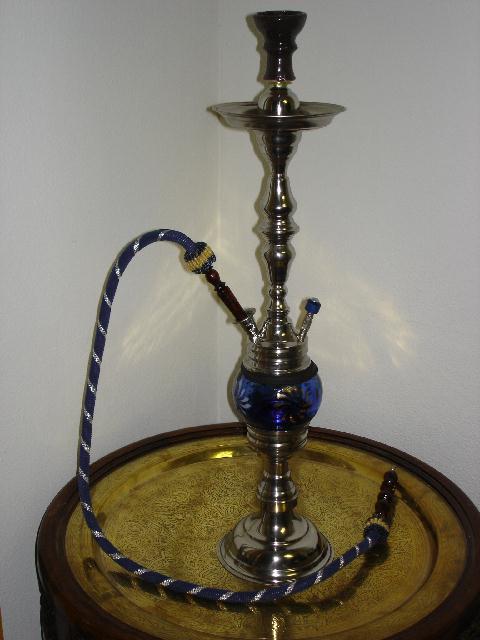
If the hookah you own looks like any of the photos in this post, you ought to be worried because no matter what you were told when you purchased it, these hookahs were all ma
nufactured in China. The materials used in the manufacturing process in China are chosen not for their safety or durability, but for their low cost. Anyone who has ever come to our shop with a Chinese made hookah in tow has had the same complaint: the material painted on the shaft to give it color comes off after exposure to the water in the base. Think about it, hookah fans! If the shaft of your hookah is painted and that paint wears off due to its being submerged in water, what materials are being emitted into the water and then passed through it to your lungs? Do you have any clue what that paint is made of or if it contains lead?


Not sure if your hookah was manufactured in China? Here are some things to look for on your hookah to determine if it was made in China:
  • It comes in a hard shell carrying case. (Only hookahs made in China come in these cases! Some unscrupulous eBay sellers are calling these Chinese fakes "Egyptian" hookahs because they purchase the Chinese ones after they have been imported to Egypt. Just because you bought a Chinese hookah in Egypt does NOT make it an authentic Egyptian hookah, peeps!)
  • It has a ceramic bowl or head. (Authentic Egyptian hookahs come with bowls made from the rich clay found along the banks of the Nile River. Why would the Egyptians import Chinese porcelain bowls when they've got a riverbed lined with some of the best clay in the world and artisans who earn their living turning that clay into products?)
  • The shaft is painted the same color as the base. (Hookahs made in Egypt never, never have painted shafts! The authentic Egyptian hookah will have a stainless steel or brass shaft which means you have a choice of two colors only -- silver and gold. If your hookah has a blue, green, red, or black shaft, it was made in China.)
  • The base is plain or painted with a design that is easy to reproduce. (Because they are made by machinery, Chinese hookahs typically have no design on the base. No artisan has ever touched the Chinese made hookah, thus it is plain and undecorated. Any hookahs made in China that do have designs on them are so pathetically decorated that it is easy to see that a machine, not an artist, did the work on them. These hookahs are virtually identical in appearance with no originality to them whatsoever. Boring!)
  • It has a "washable" hose. (Since we've been manufacturing hookah hoses in Egypt for four generations, we know that there is no such thing as a truly washable hose. Why? Because inside each hose is a wire coil around which the tubing that makes up the hose itself is wrapped. Even if the exterior layer is made of leather, pleather, or some other man made material, the inside is still a wire coil that will rust and degrade over time. The process is only sped up when water is run through the so-called "washable" hose! Honestly, the washable hose is a clever marketing strategy; however, the truth about them will win in the end.)


  • It has flashing lights in or on the shaft. (No self-respecting Egyptian hookah manufacturer would ever debase a much loved cultural icon with flashing lights. Barnum and Bailey were not Egyptian, and cheap tricks won't impress the true hookah enthusiast!)

  • Its hoses are made of pleather and have none of the characteristic decorative elements characteristic of the authentic Egyptian hookah hose. (Authentic Egyptian hookahs have marvelous hoses that are designed to enhance the smoking experience in a variety of ways. First, they must be aesthetically pleasing because so much of the hookah experience is about social interaction. Who wants to share a hookah with friends when the hose is just plain or just plain ugly? Besides, fancier hoses are also a social determiner; people with money can afford to have more elaborately decorated hoses to share with their friends. Second, length and circumference varies based on the size of the hookah to which the hose is attached. Whereas the Chinese hookahs are a uniform circumference irrespective of the height of the hookah, authentic Egyptian hookahs have hoses made to fit the height of the pipe. The bigger the pipe, the fatter the hose. Third, authentic Egyptian hookahs come with the same number of hoses as the hookah will hold. Chinese made hookahs may be able to hold up to four hoses, but it's not likely that you will get four hoses with your hookah! This is another clever marketing strategy on the part of those who deal in Chinese made products.)

  • It has an acrylic base. (Authentic Egyptian hookahs always have a glass base blown by a master craftsman and more often than not, hand painted by an artist. You will never find an authentic Egyptian hookah with an acrylic base -- NEVER!)

If the hookah you own looks like any of the photos in this post, you've been had! Your hookah was manufactured in China. There is nothing authentic about it, unless you consider an authentic fraud a positive. If you do own a hookah that was made in China, you should be especially concerned about using it considering the recent recalls of Chinese made products other than toys.

Stained Glass Hookahs

The beauty of stained glass windows in the cathedrals of Europe is surely a sight to behold. The dedication and craftsmanship required to produce such magnificent art is, sadly, for the most part, locked away in the past. In our fast-paced world, most people have fail to appreciate or understand the time and attention to the detail that goes into producing such finely crafted pieces of art, thus they are unwilling to pay a fair market value for them. If a craftsman will not be adequately compensated for his work by consumers who desire what he has produced but are unwilling to pay for it, he must turn to other avenues to earn a living and when this happens, arts and crafts are lost to future generations.


When Ali came across an artist in Egypt who had a penchant for painting stained glass Arabesque designs on hookah bases, he quickly hired him to design glasses exclusively for us. We know a true treasure when we see one and are determined to keep the arts and crafts movement alive and well in Egypt! These stunning hookahs can't be found anywhere else, unless I was nice enough to allow one of our wholesale customers to buy a few from us and when I did, it was only a couple of select models.

These authentic Egyptian hookahs come in a variety of shapes and sizes ranging from the traditional to the batta (Arabic for "duck" and referring to the rounded bottom which resembles a duck's, shall we say, "waddle"?) to the pyramid.

The stained glass look, such as the one on the right, is available in 22-inch one and two hose models or 32-inch one, two, three, or four hose models. With so many colors on the glass, the possibilities for hose options are amazing: red, yellow, blue, green, maroon, and black all look fantastic on this hookah! Best of all, these are colors that we have in stock at all times. You could have matching hoses in a single color, or with a multi-hose hookah, choose two, three, or even four different colors -- that's a different colored hose for each smoker. Just imagine the creative possibilities with this one glass!


The amber colored Arabesque hookah is unique both for its design and its color. The picture on the left shows it in the batta shape, but it is also available in the traditional style. Warm amber colored glass is hand painted with black and gold Arabesque designs. The best thing about these glasses is that because each one is painted by hand, the designs vary slightly on each glass. This means that every one is slightly different, resulting in a 100% unique hookah every time.

We firmly believe that to keep the arts and crafts of the past alive, we need to do more than admire them in photos. We need to pay tribute to the men and women who keep these time-honored traditions alive by sharing their craftsmanship with the world. Machine-made goods are fine for some things, but they will never be able to reproduce the artistry of the human touch or add the charm from an artist's hand to a product!

Egyptian Food and a Hookah Party

This weekend we went to a graduation party for a friend's son. The party was made up mostly of Egyptians and fabulous food, both of which reminded me of what makes a great hookah party. If you've never had Egyptian food, you don't know what you're missing! So, to help you have an authentic hookah party this summer, I'm going to share some authentic Egyptian recipes with you.

Egyptian Pita Bread – 6 pieces

Bread is a mainstay of every Egyptian meal. It is seldom eaten on its own and more often torn into small, bite-sized pieces and used as a scoop to hold a tasty morsel of something else.

**Note: You may use wheat flour instead of white for this recipe if you prefer.**

Ingredients

2 tsp dry yeast
1 c warm water
1 tsp salt
3 c flour (not the self-rising kind!)

Method

1. Dissolve the yeast in warm water and set aside.
2. Sift together flour and salt.
3. Add yeast and water to the flour and salt mixture until it forms a soft dough.
4. Knead the dough until it has a slightly elastic texture.
5. Cover the dough with a damp cloth and let it rise in a warm place for 3 hours.
6. Preheat the oven to 350 degrees F.
7. Divide the dough into six equal parts and roll into balls.
8. Flatten each ball into a 5-inch circle that is about ½-inch thick. You can do this with your hand or a rolling pin, whichever way you are most comfortable with. I use my hands because I prefer to do things the old-fashioned way.
9. Place on an ungreased cookie sheet and bake for 10-15 minutes until a light golden brown.


Babaghanouj

This has to be my very favorite Egyptian dish of all time and one that is very popular with people who are unaccustomed to eating Egytian food. Babaghanouj is a dip eaten with the pita bread. This recipe makes enough to serve 10-15 people as an appetizer.

Ingredients

3 medium sized eggplants
1 medium sized onion
3 Tbsp lemon juice
1 Tbsp white vinegar
½ c tahina (tahini)
1 tsp ground cumin
3-5 cloves garlic, crushed
2-3 Tbsp extra virgin olive oil
Salt and pepper to taste

Method

1. Roast the eggplants and onion, in their skins, over an open flame. This can be done on your stovetop. Be sure to cover the area with aluminum foil first, because the eggplant will ooze and make a bit of a mess. When one side begins to ooze, turn the eggplant over. The entire process will take approximately 15-20 minutes.
2. Place hot, roasted eggplants and onion in a plastic bag that you can seal. I use a plastic grocery bag, but a Ziploc baggie will work equally well. Let them sit in the bag for about 30 minutes until they are warm yet cool enough to handle.
3. Remove the eggplants and onion from the plastic bag and peel. Keeping them in the plastic bag does something magical to them that makes peeling really easy!
4. Place all ingredients in a food processor and mix until smooth.
5. Taste. The roasted flavor of the eggplant should be the dominant taste, but it should also have a bit of a zing from the lemon. Add lemon juice, one teaspoon at a time, to desired level of zing.

Pour onto a platter and smooth the top with the back of a spoon. Sprinkle chopped parsley around the edges and drizzle olive oil very lightly over the top. Serve with pita bread.

This bread and dip recipe will get you started, but I have several more to come. Heck, if you wanted to, you could serve an entire meal of nothing but Egyptian food to go with your Egyptian hookah!

Bon apetit, as Julia Child used to say!

Karma Chameleon

The past few days have been interesting, indeed, as far as hookahs are concerned. There must have been a cosmic force at work on the imposter Chinese hookahs because I answered no fewer than half a dozen phone calls from upset people who, without knowing any better, bought a Chinese hookah insead of an authentic Egyptian one. Why they call us, I haven't quite figured out yet; we don't sell Chinese hookahs! I finally came to the conclusion that they call us because we make ourselves available to our customers where other eBay sellers don't.


Anyway, back to these nasty little imposter hookahs. . . Two people who owned them discovered that the paint on the glass peels off quite easily after the glass has been washed a couple of time. One man was concerned about the metal from which the shaft is made because it is, as he said, "very light weight." Yet another had purchased a hookah with a screw-in shaft only to discover that the threads stip easily. Had these poor souls done their homework before buying a hookah, they would have been able to tell the difference between the Chinese and Egyptian hookahs. Not sure what those differences are yourself? Check out our Hookah Comparison Chart!

We are still unpacking boxes and shelving the treasures they hold. Ali did a great job of choosing such a diverse group of bases and, oh, the colors are outstanding! Because we really do listen to our customers, we can now boast that we have red roting hookahs! I will be sure to get some photos this weekend and will post one here. Meanwhile, you can look at the other rotating hookahs that we have for sale in our eBay store:

Do your homework, and you will soon discover that we have unbeatable prices!

Cultural Device vs. Drug Paraphernalia

The funniest thing happened at our warehouse today! A very nice young man who bought a hookah from us on Friday came in looking rather flustered. Since Ali was busy preparing a huge order for a wholesaler, I went to the showroom to greet the poor fellow. It turns out that he needed a replacement glass because his was already broken. When I asked him what happened, especially because he hadn't had the hookah very long, the guy tells me that he and group of friends spent the weekend at another friend's beach house. He took his brand new hookah with him to share with his buds. The guys had a great time on Saturday night mixing different shisha flavors with each bowl and judging who had come up with the best mix. All was great until early Sunday morning when our customer was awakened to the sound of shattering glass. Thinking that a robbery was underway, the guys all jumped out of bed and went running in various directions through the house. Imagine our customer's surprise when he dashed into the kitchen and found his friend's mother with a hammer in her hand and his hookah smashed to smithereens! Turns out the mom thought that her son and his buddies were using drugs in that thar hookah and wanted to let them all know that she wasn't going to tolerate it, especially in her home. Feeling rather embarrassed when the guys explained all about the hookah, the mom gave our cusstomer money to replace the one she destroyed.

All's well that ends well, I suppose. . .

But still, I am left wondering how many people still have that 60's mentality about the hookah? I'm not so silly as to think that there aren't people who use the hookah for substances other than what it was intended for, but surely those folks aren't dumb enough to drag a 32" pipe with them from house to house while they party, right? And hello, from what I remember of my younger days, pot and shisha have vastly different aromas! Since when was the last time you smelled pina colada flavored marijuana, LOL?!